by Daniel Brouse
November 18, 2025
Updated 2026
Many people believe that planting trees is one of the most important ways to help save the planet and reverse climate change. Planting trees can certainly help—but planting a tree and growing a healthy, mature forest are two very different things.
The problem is that climate change is increasing the stresses that kill trees and changing where forests can survive. Rising temperatures, increasing vapor pressure deficits, drought, extreme heat, wildfire, flooding, disease, and insect outbreaks are interacting in ways that can overwhelm trees faster than forests can adapt.
Wildfire is an increasingly important part of the problem. Climate-driven increases in fire weather have contributed to substantially greater forest and tree-cover losses in many regions. Drought and extreme heat compound that damage by reducing soil moisture while increasing the atmosphere's demand for water. A key measure of this atmospheric demand is vapor pressure deficit (VPD)—the difference between how much moisture the air can hold and how much it actually contains. As temperatures rise, VPD can increase sharply, making the atmosphere effectively “hungrier” for water.
VPD is the atmospheric driver; evapotranspiration is the biological and physical response. As VPD rises, trees generally increase transpiration—the movement of water from soil, through the plant, and out through the leaves—as long as sufficient soil moisture is available. This evaporative cooling helps regulate leaf temperature. But when VPD becomes too high, or when soil moisture cannot keep pace with atmospheric demand, trees can reach a physiological tipping point. They close their stomata to reduce water loss, which suppresses transpiration and therefore evapotranspiration. The tree may conserve water in the short term, but it also loses evaporative cooling, increasing leaf temperature and physiological stress. Prolonged or extreme stress can ultimately lead to hydraulic failure, carbon starvation, tissue damage, and tree mortality.
Tree mortality is also occurring through less spectacular but equally important pathways. Long-term studies have documented increasing mortality in some tropical forests, while drought, heat, insects, and disease have produced severe die-offs in temperate and boreal forests. In California, prolonged drought and heat have contributed to the death of tens of millions of trees. Elsewhere, drought and increasingly volatile weather have reduced the survival of newly planted trees and complicated reforestation efforts.
This creates a fundamental problem with the simple “plant more trees” solution.
A planted seedling must first survive. Then it must grow large enough to become ecologically significant, reproduce, and ultimately become part of a functioning forest. A tree that dies after a few years has absorbed only a fraction of the carbon it might have stored over decades—and the resources invested in planting it may accomplish little. Multiple prominent scientific studies and forestry reports confirm that replanted saplings face staggering failure rates, with mortality exceeding 70% to 80% within 5-to-10-years.
That is why tree survival matters as much as tree planting.
Multiple studies of reforestation and tree establishment have found substantial seedling mortality, particularly under drought, heat, competition, poor site conditions, and other environmental stresses. Mortality can become extremely high when newly planted trees encounter conditions outside the climate range to which they are adapted.
The question for the future, therefore, is not simply:
How many trees can we plant?
It is:
Which trees can survive long enough to become the forests of tomorrow?
That is the question behind this experiment.
On March 4, 1681, King Charles II granted William Penn a royal charter for a vast tract of land in North America. The grant contained more than 28 million acres, making it one of the largest private land grants in history. The King awarded the territory to Penn partly to settle a debt of £16,000 owed to Penn’s late father, Admiral Sir William Penn.
But the story behind the name is especially fitting for a state whose identity is so closely tied to its forests.
William Penn wanted to call his new territory “Sylvania,” from the Latin silva, meaning woodland or forest. In other words, Penn envisioned a land defined by its woods.
King Charles II, however, insisted that “Penn” be placed before Sylvania to honor Admiral William Penn. The result was Pennsylvania—literally, “Penn’s Woods.”
Penn reportedly worried that people would assume he had named the colony after himself, when the name was actually the King’s tribute to his father.
More than three centuries later, the name remains remarkably appropriate.
Penn’s Sylvania was a land of forests.
The question now is whether the forests that gave Pennsylvania its name can survive the rapidly changing climate of the land itself.
Since the 1960s, I have studied trees in Pennsylvania. Over the decades, I have watched the conditions affecting our forests change—and, more recently, deteriorate rapidly. Several factors are driving this decline, including ozone pollution, hydroclimatic whiplash, and ecosystem conversion.
The goal is not simply to document what is happening, but to find ways to adapt to the conditions we have now while working to change the trajectory that is producing them.
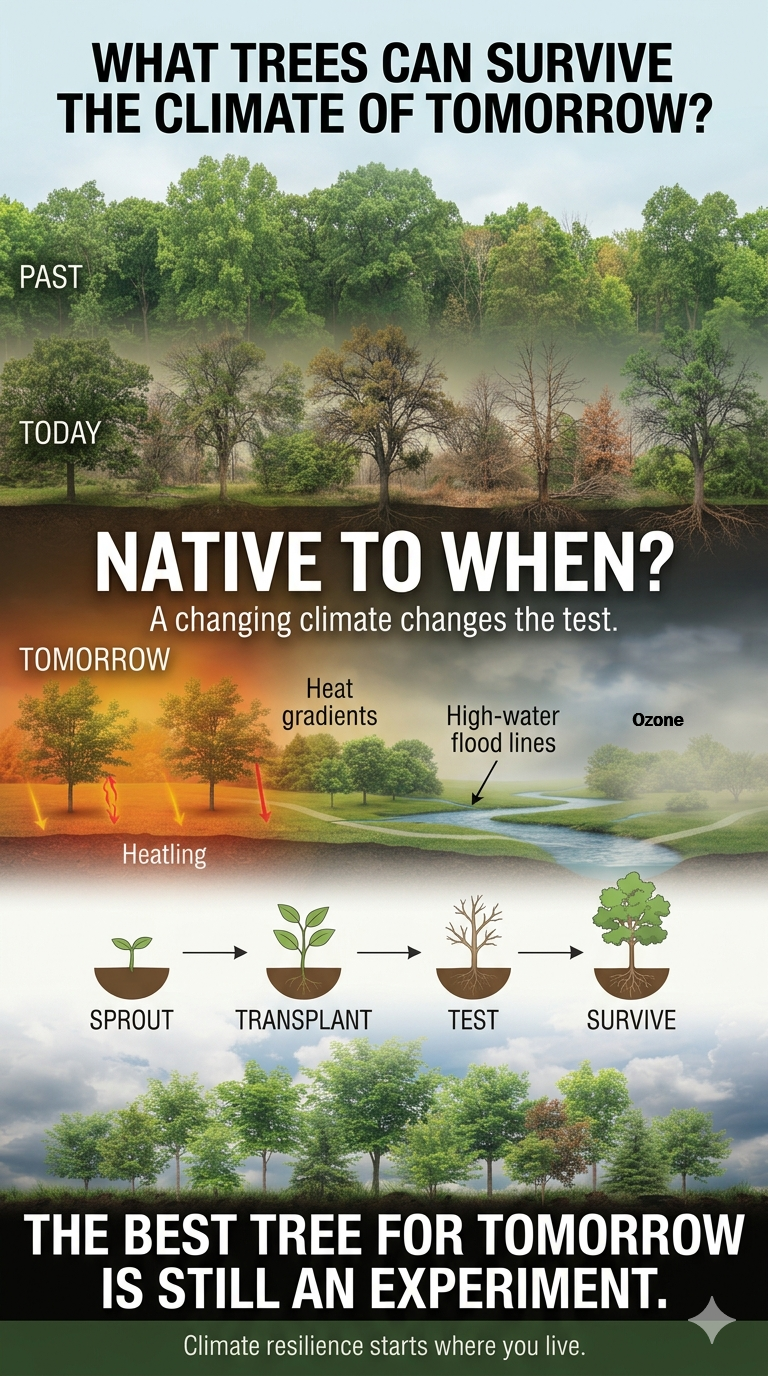
Unfortunately, “native species” is not necessarily the answer—at least not without defining what we mean by native and, more importantly, native to when? A species that evolved in Pennsylvania under the climate of the past may not necessarily be well suited to Pennsylvania’s rapidly changing climate today.
That is the premise behind this experiment.
I transplanted trees that began sprouting naturally around my property, along with trees I obtained for free or on special occasions. Some were Arbor Day giveaways. Others were small ornamental trees purchased at post-Christmas sales. Nothing particularly scientific or selective went into acquiring them. They were simply trees that became available to me.
For several years, I have been testing these trees for climate resilience in my location.
That may be one of the most useful ways to identify the trees of the future: an evolving experiment conducted where you actually live. There is no single “best tree” for tomorrow because tomorrow’s climate is still changing—and the speed and acceleration of that change remain uncertain.
One of the most troubling findings is that many of the species we traditionally regard as Pennsylvania’s native trees are struggling under today’s conditions. Some of the old-growth species that once thrived here may no longer be capable of surviving, much less thriving, under the climate they now face.
The question, then, is not simply “What trees are native here?”
It is:
“What trees can survive here as the climate continues to change?”
For decades, we have studied the trees of Pennsylvania, tracking shifts in canopy structure, species resilience, and environmental stressors. Our long-term field data reveal a profound and accelerating decline. Since 2003, old-growth trees have consistently lost about 40% of their foliage over multi-year intervals, leading to premature mortality. During the same period, canopy height has fallen by roughly one-third, a drastic structural collapse in forests that once represented stability and ecological longevity. These changes are not isolated -- they mirror global patterns of forest decline -- but Pennsylvania offers one of the clearest windows into the cascading pressures reshaping ecosystems worldwide.
The primary drivers of this decline are not singular. Chronic ozone exposure weakens leaf tissues, reduces photosynthetic capacity, and lowers defenses. Warming temperatures, heat stress, hydrological whiplash (extreme swings between drought and deluge), and the spread of pests and disease compound these vulnerabilities. Together, they form a multifactorial stress landscape in which even historically resilient species cannot recover. The number of tree species capable of surviving under modern conditions is shrinking rapidly.
As the canopy thins, an unexpected force rises: vines. In Pennsylvania's forests, species like wild grape, kudzu, and bittersweet take advantage of the increased sunlight penetrating the weakened upper layers. Vines, once confined to understory limits, now climb higher each year. When they reach the diminished canopy, they smother, shade, and eventually kill the already stressed trees. This vine-driven mortality accelerates the loss of old growth and destabilizes the entire forest system -- affecting biodiversity, soil retention, and wildlife habitat. What was once a finely balanced ecosystem now tilts toward collapse.
This local unraveling echoes a global trend. Across Canada, much of the northern United States, and parts of Europe, old-growth forests face similar failures. The wildfire-ravaged forests of Canada highlight the challenge: replanting the same species no longer guarantees success when temperature and moisture regimes have shifted beyond their tolerance. Trees that would have thrived for centuries can no longer survive long enough to mature. Reforestation guided by historic baselines is now a losing strategy; adaptive management that anticipates the climate of 2050-2100 is essential.
In Pennsylvania, our work increasingly focuses on identifying species suited to emerging conditions. Trees with rapid regrowth, high heat tolerance, and broader ecological plasticity show the strongest potential.
A diverse mixture of trees provides the greatest resilience.
Both deciduous and evergreen (conifer) species should be included whenever practical.
Deciduous trees provide:
Evergreens provide:
Nature often contributes to the experiment as well. Birds, squirrels, and the wind frequently plant volunteer seedlings that can be transplanted into containers.
During the Pennsylvania experiment, these trees included species that appeared naturally on the property, along with species that were transplanted or obtained as inexpensive or free trees:
By contrast, some species have performed poorly. Many pines, for example, lack the ability to regenerate vigorously from damaged tissues and may be particularly vulnerable when heat, drought, insects, disease, and repeated disturbance occur together.
The purpose of the experiment is not to declare a single “best” tree. It is to observe which species can actually survive, recover, and grow under the changing conditions of Pennsylvania.
One of the most promising candidates for future forests is the black locust. Reaching heights of up to 100 feet and lifespans of 75-90 years, black locusts combine durability, rapid growth, and climate resilience. Their wood is exceptionally strong -- with a Janka hardness of approximately 1,700 lbf, rivaling or exceeding that of white oak and golden teak. Their natural resistance to rot, ability to recover from damage, and tolerance of heat and drought make them remarkably suited for 21st-century conditions. Black locust sprouts vigorously from stumps and roots after cutting or damage. As hardwoods that also fix nitrogen, locusts help rebuild soils damaged by erosion and extreme rainfall.
The tulip poplar (Liriodendron tulipifera) is one of Pennsylvania's most impressive native hardwoods and one of the fastest-growing trees in eastern North America. Under favorable conditions, it can exceed 100 feet in height and live for well over a century. Its rapid growth gives it an important advantage in a changing climate: it can quickly capture growing space, accumulate biomass, and establish a substantial canopy.
Tulip poplar also has a relatively broad natural range and can grow across a variety of soils and moisture conditions. Its deep root system helps anchor the tree and allows established trees to access water below the surface. These characteristics make it an interesting candidate for a warmer, more hydrologically variable Pennsylvania.
There are, however, important limitations. Tulip poplar is generally considered a moisture-demanding species and can be vulnerable to prolonged drought, particularly when young. Its rapid growth does not necessarily translate into exceptional drought resistance. Increasing heat and atmospheric drying could therefore become an important test of its long-term resilience.
That combination makes the tulip poplar particularly interesting in this experiment. It represents a native Pennsylvania tree that is exceptionally good at growing when conditions are favorable—but the question is whether its growth rate and adaptability will be enough to compensate for increasing heat, drought, and hydroclimatic whiplash.
The experiment is not simply asking how fast the tulip poplar can grow. It is asking whether it can keep growing as the climate changes around it.
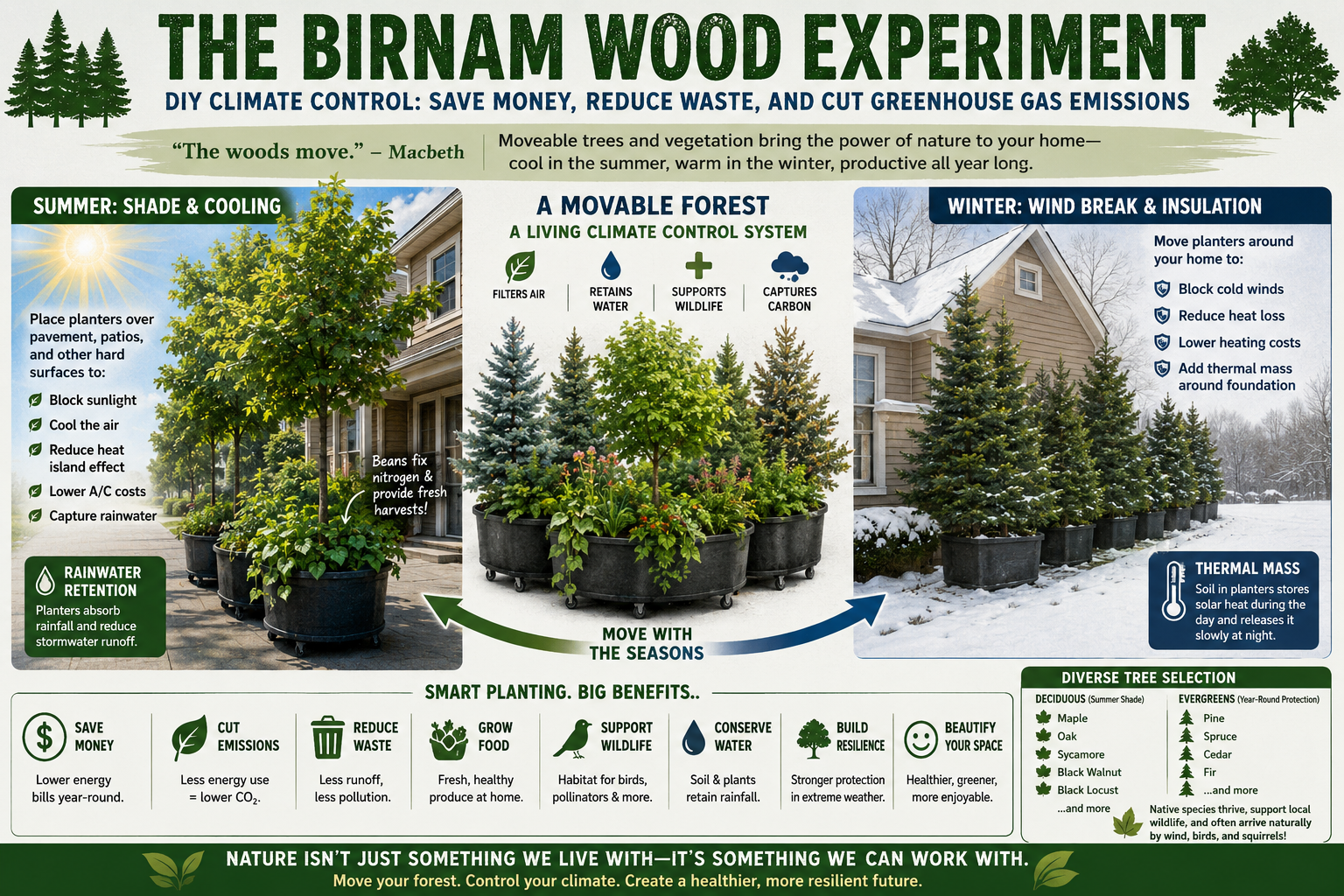
In Shakespeare’s Macbeth, Birnam Wood appears to come alive as Malcolm’s army cuts branches from the forest and carries them toward Dunsinane Castle, concealing its advance. What seemed like magic was actually an ingenious use of nature to solve a practical problem.
The Birnam Wood Experiment applies that same concept to climate resilience by using moveable trees and vegetation to improve home energy efficiency, reduce urban heat, harvest rainwater, provide food, and create healthier outdoor living spaces.
Rather than planting every tree permanently in the ground, many are grown in large mobile planters that can be repositioned throughout the year wherever they provide the greatest environmental and economic benefit.
The Birnam Wood Experiment: Moving Forests for a Cooler, More Efficient Home
Pennsylvania's forests are not simply changing—they are being reorganized by a changing climate. Chemistry, physics, biology, land-use change, drought, extreme precipitation, heat, insects, disease, and wildfire are interacting in ways that can push trees beyond the conditions under which they evolved.
The decline of older trees is therefore more than an ecological signal. It is a warning that the climate supporting Pennsylvania's historic forests is changing faster than many of those forests can adapt.
That does not mean that Pennsylvania's forests are doomed. It means that the forest of the future may not look like the forest of the past.
The answer cannot simply be to plant more trees. We need to determine which trees can survive, recover, reproduce, and establish functioning forests under the conditions that are actually developing. That may require a broader definition of what belongs in Pennsylvania's future forests—including species that are not traditionally considered native, while carefully evaluating their ecological consequences.
This experiment is an attempt to observe that process at the ground level: tree by tree, species by species, year by year.
Pennsylvania was named for its woods—Penn's Sylvania.
The question facing us now is not whether Pennsylvania will have forests.
What kind of forest will Pennsylvania have when today's seedlings become tomorrow's trees?
The old equilibrium is changing. Our task is to discover whether we can help establish a new one—one resilient enough to survive what comes next.